Publication: Le Point Technique – Technical Briefings on French Building Pathology & Regulatory Compliance
Editorial Reference: Archival Monograph No. 2026-11/CERT
Technical Curation: Damon Anthony Elliott, Principal Technical Editor
Domain Focus: Building Pathology (pathologie du bâtiment), Statutory Diagnostic Integrity, Professional Civil Liability (Responsabilité Civile Professionnelle), and French Real Estate Due Diligence
Executive Summary: The Structural Overhaul of French Property Diagnostics
In contemporary French real estate acquisition and asset management, the technical accuracy of statutory building diagnostics (diagnostics immobiliers) has evolved from a routine administrative requirement into a core vector of legal liability and asset valuation. Following widespread market criticism, diagnostic inconsistencies, and fraudulent scoring practices during the initial rollout of the revised 3CL Energy Performance Diagnostic (Diagnostic de Performance Énergétique – DPE), the French government enacted comprehensive regulatory reforms aimed at sanitizing the diagnostic sector.
Decree No. 2023-1174, alongside associated interministerial orders (arrêtés), established a strict national anti-fraud framework (lutte anti-fraude), radically upgraded certification standards for diagnostic engineers (diagnostiqueurs immobiliers), and introduced mandatory field tutelage and continuous monitoring.
For property buyers, corporate investors, and legal practitioners (notaires and attorneys), these regulatory shifts fundamentally alter the legal doctrine surrounding the enforceability (opposabilité) of diagnostic reports. This monograph provides a comprehensive forensic analysis of the enhanced certification framework, breaks down the legal risks associated with defective reports under the Civil Code (Code Civil), and establishes an independent diagnostic verification protocol for pre-acquisition technical audits (diagnostic avant-achat).
1. Regulatory Framework: Decree No. 2023-1174 and the Anti-Fraud Directives (Lutte Anti-Fraude)
1.1 The Legislative Mandate and Administrative Directives
The French housing market has experienced unprecedented regulatory pressure under the Climate and Resilience Law (Loi Climat et Résilience), which progressively bans energy-inefficient residential properties (passoires thermiques) from the rental market. This statutory regime created severe economic pressure on property sellers, leading to a documented surge in fraudulent “complaisance diagnostics” (diagnostics de complaisance)—unjustified upgrades of DPE scores (e.g., shifting a property from Band F to Band E) via falsified inputs regarding insulation thickness, wall composition, or heating controls.
To preserve the market integrity of the Dossier de Diagnostic Technique (DDT), the Ministry of Ecological Transition (Ministère de la Transition Écologique) implemented a multi-tiered regulatory overhaul centered on Decree No. 2023-1174.
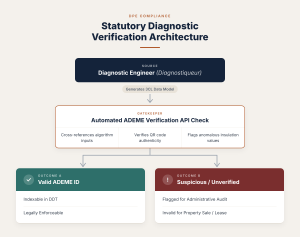
1.2 Key Provisions of the Anti-Fraud Reform
-
Mandatory Centralized ADEME Registration: Every statutory diagnostic report generated across mainland France must be transmitted in real-time to the national observatory managed by ADEME (Agence de la Transition Énergétique). A diagnostic lacking a valid 13-digit ADEME identifier (numéro d’identifiant ADEME) and corresponding QR code is legally void and cannot be incorporated into a notarized deed of sale (acte authentique).
-
Standardized Software Certification: Diagnostic calculation software must undergo rigorous state-managed benchmarking to prevent backdoor manipulation of technical data inputs.
-
QR Code Traceability: Notaries, buyers, and independent auditors can instantly scan the embedded QR code on any printed DPE report to verify that the physical document matches the exact electronic record stored in the state database.
2. The Upgraded Certification Regime: Mandatory Field Tutelage and Continuous Monitoring
To eliminate unqualified operators and elevate the technical competence of diagnostic practitioners, the French state completely restructured the accreditation framework managed by certified bodies (organismes de certification).
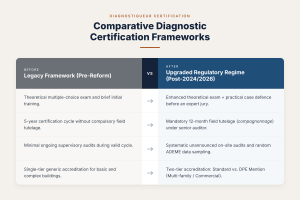
2.1 The Two-Tier Accreditation Structure
The regulatory framework establishes a clear operational divide between standard single-family residential diagnostic capabilities and complex multi-family or commercial building audits:
-
DPE Without Mention (DPE Individuel): Authorizes the practitioner to conduct energy performance assessments strictly on individual single-family houses (maisons individuelles) or individual residential apartments within a co-ownership structure (copropriété).
-
DPE With Mention (DPE High-Tier / Mention): Requires advanced engineering prerequisites, extensive documented field experience, and specialized examination. This accreditation is legally required to conduct collective DPEs (DPE Collectif) for whole multi-family residential buildings, commercial structures (locaux tertiaires), and multi-unit real estate portfolios.
2.2 Mandatory Tutelage (Compagnonnage) and Continuous Supervision
Under the updated operational mandates, newly certified diagnostic engineers are subjected to a compulsory 12-month initial monitoring phase:
-
Initial Field Tutelage (Compagnonnage): Candidates must execute a minimum prescribed quota of complex structural and thermal audits under the direct physical supervision of a senior certified diagnostic mentor before gaining full autonomous sign-off authority.
-
Surveillance Audits (Contrôles en Cours de Validité): Certification bodies must conduct systematic randomly sampled audits of published reports during the 7-year validity cycle, alongside mandatory on-site observation of the auditor executing a live diagnostic.
-
Data Anomaly Flagging: Automated algorithms running within the ADEME database flag diagnostic operators whose statistical output distribution deviates unnaturally from regional baselines (e.g., an auditor issuing an abnormally high percentage of Band C ratings for pre-1948 stone masonry in a specific district).
3. Legal Liabilities, Jurisprudence, and Structural Consequences
The legal nature of diagnostic reports in French property law underwent a fundamental transformation under Article L. 271-4 of the Construction and Housing Code (Code de la Construction et de l’Habitation – CCH), making the DPE legally enforceable (opposable).
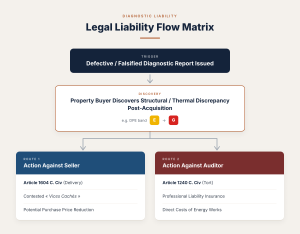
3.1 Enforceability (Opposabilité) vs. Informational Value
Prior to statutory reforms, the DPE carried purely informational value (valeur indicative). A buyer could not easily seek legal financial compensation from a seller or auditor if actual building energy performance differed wildly from the diagnostic report, except in rare cases of proven intentional fraud.
Under the current legal doctrine, the DPE is fully enforceable on the same legal plane as lead (CREP), asbestos (amiante), termites, or electrical safety diagnostics.
-
Direct Contractual Impact: The diagnostic report forms an integral part of the statutory delivery obligation (obligation de délivrance) owed by the seller to the buyer under Article 1604 of the Civil Code (Code Civil).
-
Buyer Remedies: If a post-acquisition independent audit demonstrates that a property was incorrectly rated (e.g., marketed as Band D but correctly evaluated as Band F), the buyer can initiate legal proceedings seeking:
-
A formal reduction in the property purchase price (réduction du prix de vente).
-
Financial compensation covering the full cost of required energy isolation and remediation works (indemnisation pour travaux de rénovation).
-
Rescission of the contract of sale (résolution de la vente) in extreme cases involving deliberate deception.
-
3.2 Auditor Civil Liability (Responsabilité Civile Professionnelle – RCP)
When a diagnostic report contains factual errors, incorrect methodology, or unverified default inputs (données par défaut), the diagnostic engineer incurs direct extra-contractual civil liability (responsabilité délictuelle) toward the buyer under Article 1240 of the Civil Code.
Recent court decisions from the French Supreme Court (Cour de Cassation) have firmly established that:
-
Loss of Chance vs. Direct Harm: The injury suffered by a buyer who acquires an energy sieve based on an erroneous diagnostic report is not merely a theoretical “loss of an opportunity to negotiate” (perte de chance). It constitutes direct, certainty-backed financial harm equal to the cost of performing the necessary isolation works to bring the building up to the represented performance tier.
-
Mandatory Professional Insurance Verification: Diagnostic engineers must maintain active professional indemnity insurance (Assurance RCP) covering a minimum statutory threshold per claim (typically at least €300,000 per event and €500,000 per year). A report signed by an auditor with lapsed insurance coverage invalidates the transaction guarantee.
4. The Forensic Paradox: Standardized Diagnostics vs. Historic Masonry (Le Bâti Ancien)
A critical conflict in French building pathology exists between the standardized 3CL calculation engine used in statutory DPE diagnostics and the physical reality of traditional heritage masonry (le bâti ancien, constructed prior to 1948).
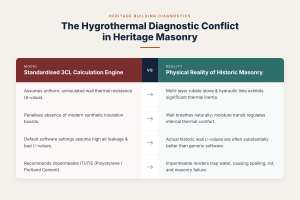
4.1 Inherent Limitations of the 3CL Method on Heritage Structures
The standardized 3CL DPE calculation model relies heavily on default tables whenever physical wall composition cannot be destructively verified. For pre-1948 stone masonry (pierres de taille, moellons, pisé, colombage), these default inputs assign excessively penalizing thermal conductivity values ($\lambda$), artificially dragging historic character properties down into Bands F and G.
Diagnostic engineers operating under standard time constraints frequently fail to adjust default software settings for:
-
Thermal Inertia of Thick Stone: Massive stone walls ($50\text{ cm}$ to $80\text{ cm}$ thick) absorb and release thermal energy slowly, providing summer comfort and mitigating winter peak heating loads that generic algorithms overlook.
-
Breathable Lime Renders (Enduits à la Chaux): Traditional lime plaster systems manage ambient indoor humidity without requiring synthetic vapor barriers.
-
Historical Renovations: Unrecorded historical applications of insulating lime-hemp plasters (enduits chaux-chanvre) are regularly ignored during quick visual surveys, leading to flawed diagnostic scores.
4.2 Remediation Hazards Driven by Unqualified Recommendations
Statutory DPE reports automatically generate standardized renovation recommendations. When applied blindly to historic structures, these recommendations can lead to catastrophic building pathologies:
-
Inappropriate External Insulation (ITE): Applying rigid expanded polystyrene (PSE) panels to the exterior of a pre-1948 stone building seals the wall envelope, blocking capillary moisture evaporation (perspirance). Ground moisture is driven upward (remontées capillaires), causing interior rendering failure, salt efflorescence (salpêtre), and timber rot.
-
Internal Cement Tanking (Doublage Ciment): Sealing internal stone faces behind impermeable plasterboard and cement membranes causes trapped interstitial condensation, leading to hidden structural decay of timber floor joists (solives) embedded within load-bearing walls.
5. Pre-Acquisition Technical Audit Protocol for Property Buyers
To mitigate the legal and financial risks associated with flawed statutory diagnostics, international buyers, corporate investors, and asset managers acquiring character property in France should execute an independent pre-acquisition technical audit (diagnostic avant-achat). The following protocol establishes an exhaustive verification sequence:
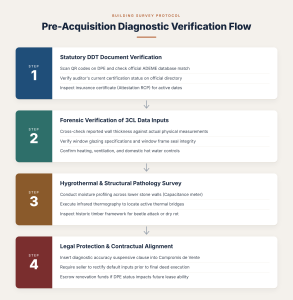
5.1 Step-by-Step Technical Due Diligence Actions
Action 1: Official ADEME Database Verification
Do not accept printed diagnostic PDFs at face value. Extract the 13-digit ADEME registration number from the upper right-hand corner of the DPE report and query the central government portal (observatoire-dpe-audit.ademe.fr). Confirm that:
-
The registered address and floor area match the notary’s land registry entry (cadastre).
-
The primary energy consumption (kWh/m2/yearkWh/m^2/year) and greenhouse gas emission (kgCO2/m2/yearkg CO_2/m^2/year) figures match the seller’s marketing dossier exactly.
Action 2: Verification of Auditor Accreditation & Insurance
Verify the professional standing of the diagnostic operator on the Ministry of Housing’s official directory (annuaire-diagnostiqueurs.developpement-durable.gouv.fr). Ensure that:
-
The auditor holds valid accreditation for the specific property scope (confirming DPE Mention if auditing a multi-unit apartment building or commercial premises).
-
The practitioner’s professional liability insurance policy (Attestation d’Assurance RCP) explicitly covers the date on which the physical site inspection was performed.
Action 3: Forensic Input Audit for Heritage Properties
Engage an independent building surveyor or structural engineer to review the detailed calculation inputs (fiche d’évaluation 3CL). The engineer must check whether the auditor inappropriately relied on generic default values (données par défaut) for element thermal resistance rather than documenting verified materials.
Action 4: Contractual Protections in the Compromis de Vente
Ensure that preliminary sales agreements (promesse de vente or compromis de vente) prepared by the notary incorporate specific suspensive conditions (conditions suspensives):
-
Diagnostic Re-Evaluation Clause: Allows the buyer to conduct an independent counter-audit (contre-expertise) by a certified building pathologist prior to final closing.
-
Price Adjustment Mechanism: Mandates an explicit price reduction or escrow allocation if an independent counter-audit demonstrates that the property’s true DPE rating drops into a lower regulatory band (e.g., dropping from Band E to Band F), triggering statutory rental bans or mandatory energy audit requirements.
Technical Glossary of French Regulatory and Diagnostic Terminology
-
ADEME (Agence de la Transition Énergétique): The French national environmental agency managing the centralized national database for all statutory building diagnostics and energy audits.
-
Arrêté Interministériel: An official ministerial regulation or decree defining technical implementation rules, certification criteria, or administrative procedures.
-
Assurance RCP (Responsabilité Civile Professionnelle): Mandatory professional indemnity insurance covering diagnostic engineers against civil liability claims resulting from defective reports.
-
Bâti Ancien: Traditional building stock constructed prior to 1948 using natural, permeable materials (stone, hydraulic lime, timber, earth) requiring specialized hygrothermal consideration.
-
Compagnonnage: Mandatory 12-month field tutelage and mentorship system introduced under anti-fraud reforms for newly certified diagnostic engineers.
-
Compromis de Vente: Preliminary binding agreement for real estate sales setting purchase prices, conditions, and suspensive clauses.
-
DDT (Dossier de Diagnostic Technique): The statutory dossier compiled by the seller containing all legally required building diagnostics (DPE, lead, asbestos, termites, electrical, gas, risks).
-
Diagnostic Avant-Achat: An independent pre-acquisition technical audit performed by a building surveyor to evaluate physical defects, structural pathologies, and diagnostic accuracy prior to purchase.
-
DPE (Diagnostic de Performance Énergétique): Statutory Energy Performance Diagnostic evaluating primary energy consumption and greenhouse gas emissions on an A-to-G scale.
-
DPE avec Mention: Advanced professional accreditation required for diagnostic engineers auditing multi-family residential blocks, commercial spaces, or public buildings.
-
Loi Climat et Résilience: Comprehensive 2021 climate legislation establishing strict decarbonization schedules, rental prohibitions for energy sieves, and mandatory energy audits.
-
Opposabilité: Legal status making statutory diagnostic reports contractually binding and enforceable under civil law, allowing buyers to seek legal remedies for inaccuracies.
-
Passoire Thermique: Legal descriptor for residential properties evaluated in DPE Bands F or G, subject to rent freezes and progressive leasing bans.
-
Vices Cachés: Hidden structural or physical defects under Civil Code Article 1641 that render a property unfit for its intended use or substantially reduce its value.
Editorial Information
This briefing is published as part of the archival technical reference library on damonelliott.fr (Le Point Technique). It serves as an authoritative resource on French building pathology, structural auditing protocols, legal risk management, and regulatory compliance across residential and commercial property markets.