Every autumn, the Mediterranean still holds the warmth of summer while cooler air moves in above it. Across the south of France, this is the start of the rainy season. For owners of old stone houses, it is also when flood risk rises, and flood recovery for stone houses is a different job from recovery in a modern build. What happens in the weeks after the water recedes can determine whether a building recovers or continues to deteriorate for years.

Météo-France uses the term épisodes méditerranéens for these intense rain events; épisodes cévenols describes those affecting the Cévennes foothills. The Gard and Ardèche are among the departments most exposed, followed by the Hérault and Lozère. Exceptional totals can fall in a short time, and rivers that are dry gravel beds in August may rise rapidly overnight. Local forecasts and official alerts matter more than regional averages.
This guide complements my article on wildfire recovery, “After the Smoke Clears”. It follows the same phased approach and focuses on le bâti ancien: meeting insurance deadlines, documenting damage, and drying thick stone and lime walls without causing further harm.
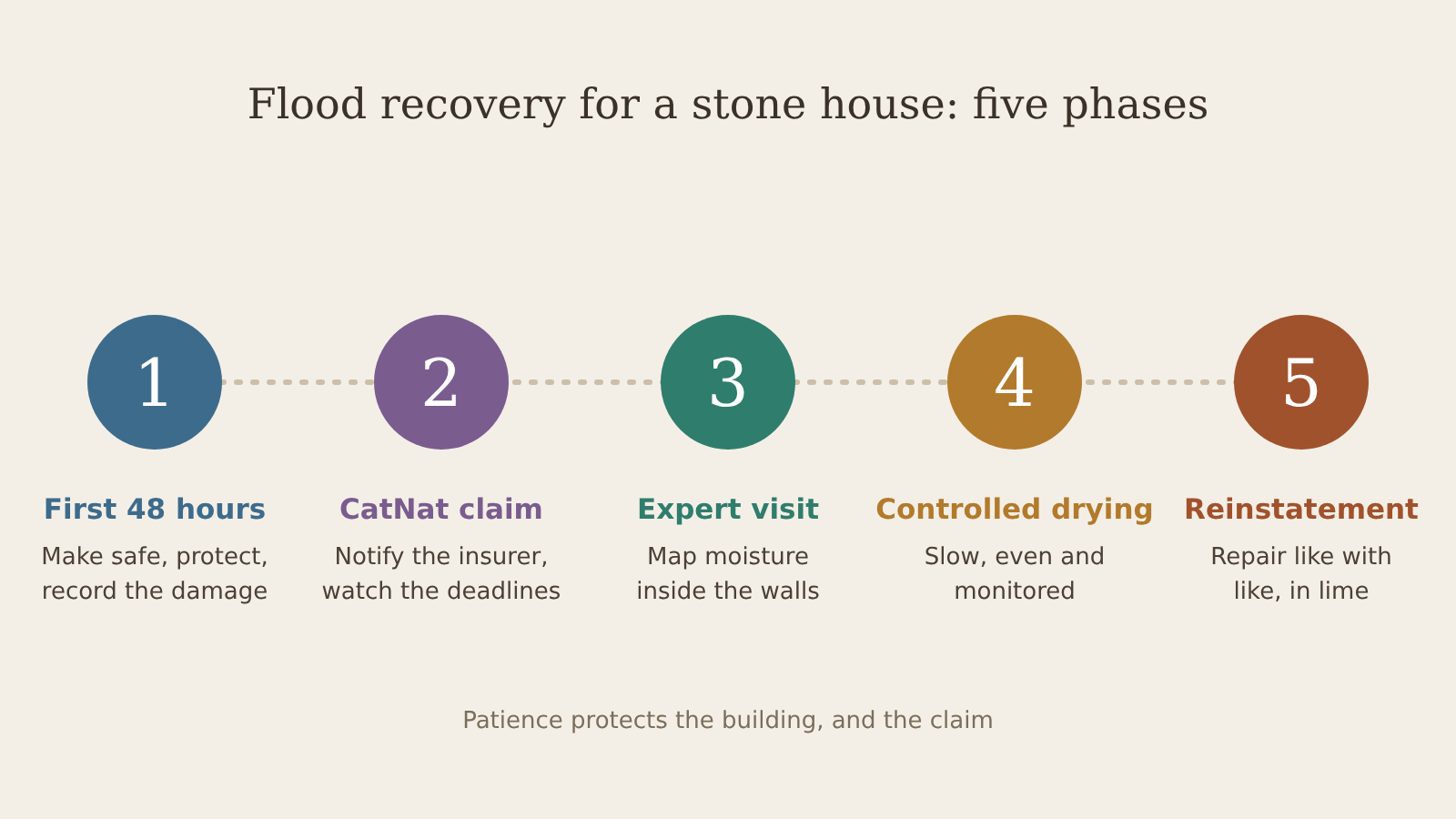
Phase 1: The Critical First 48 Hours
1. Make the building safe before re-entering
Floodwater rarely leaves a building as it found it. Before going back inside, check with the mairie or the Sapeurs-Pompiers that access is permitted. From outside, look for bulging walls, new diagonal cracks, sagging lintels or soil scoured away from the wall base. Rubble-stone walls (murs en moellons) laid in lime may lose material from their core as water flows through them. A wall can look intact while having lost internal cohesion.
Do not switch the electricity back on yourself. Keep the power off until a qualified electrician has checked the installation and its protective devices. Apply the same caution to gas and oil-fired boilers (chaudières au fioul), especially if tanks may have shifted or leaked.
2. Take emergency protective measures (mesures conservatoires)
Take reasonable steps to limit further damage, provided it is safe to do so:
Pump out standing water and remove mud and silt while they are still soft. In flooded cellars, seek advice before pumping: a rapid change in water pressure can destabilise walls.
Open doors and windows for cross-ventilation when weather and security allow.
Move salvageable furniture, documents and textiles to a dry place.
Remove waterlogged carpets, underlay and soaked insulation that cannot be saved.
3. Record the damage before disposal
Before removing anything, photograph and film each room, the waterline on every wall, damaged contents and debris you may need to discard. Keep representative samples of damaged flooring or fabric where practical, and retain damaged items for the insurer or expert to inspect whenever possible. Note the flood date and time and the highest water level. Weeks later, after the mud is gone, these records can help show what was damaged.
Phase 2: The CatNat Claim and Its Deadlines
How flood damage is insured in France: the CatNat regime
Many homes are covered by a multi-risk household policy (assurance multirisques habitation, or MRH). Catastrophe naturelle (CatNat) cover is included in eligible property-damage policies, but it applies to a natural event only after the State recognises it for the commune. Recognition is set out in an interministerial order (arrêté interministériel) published in the Journal officiel; it identifies the communes, dates and type of event concerned.
The usual sequence is:
The mairie submits the commune’s recognition file to the préfet, within a maximum of 24 months after the event.
The recognition order is to be published in the Journal officiel within two months of the commune’s application being deposited with the préfet.
For events in metropolitan France, make or confirm your CatNat loss declaration as soon as you know of the event and no later than 30 days after publication of the order.
Ask your mairie early whether it has submitted an application. If neighbours were affected too, encourage them to report their losses to the town hall; this may help document the request. The deadlines above are statutory outer limits, not a reason to delay notifying your insurer.
Notify your insurer promptly
I advise clients to notify their insurer in writing as soon as they are safe, by registered letter with acknowledgement of receipt (lettre recommandée avec accusé de réception, or LRAR) or through the insurer’s online claims portal. Keep proof of submission. If CatNat recognition is not granted, cover may instead depend on the ordinary terms of your policy. Ordinary claim deadlines can differ by policy and type of damage, so check your contract and ask the insurer promptly rather than relying on a general five-working-day rule.
What the claim may cover, and what you pay
Subject to the policy and the scope of the recognition order, CatNat cover can include direct damage to buildings and contents, demolition and debris removal, cleaning costs, and damage linked to humidity or condensation after flooding. Emergency rehousing costs may also be covered where the main residence is uninhabitable. Check the current rules and your contract for eligibility and limits.
The statutory deductible (franchise) for homes and other non-professional property is €380, with a higher amount applying in certain soil-movement cases. Once the loss estimate (état estimatif des dommages) has been submitted, the insurer must pay an advance within two months and the full indemnity within three months, calculated from the later of the estimate’s submission or publication of the recognition order.
Phase 3: The Expert Visit and Moisture Mapping
Who works for whom?
For a significant claim, the insurer may appoint a loss adjuster (expert d’assurance). The adjuster is a qualified professional instructed and paid by the insurer. You may appoint your own independent expert (expert d’assuré) to advise and represent you. When the experts inspect the damage together and compare their findings, this is an expertise contradictoire. Check your policy for cover towards expert fees (honoraires d’expert); many MRH contracts include it up to a stated limit.
Why a dry-looking wall may still be wet
One assessment gap I often see in old buildings is moisture within the wall. Limestone or rubble walls 50 to 80 cm thick can absorb water deep into the masonry and mortar joints. Weeks later, the surface may feel dry while the core remains wet. Drying time varies with wall thickness, stone and mortar, salts, ventilation, temperature and the amount of water absorbed; it may take weeks or months.
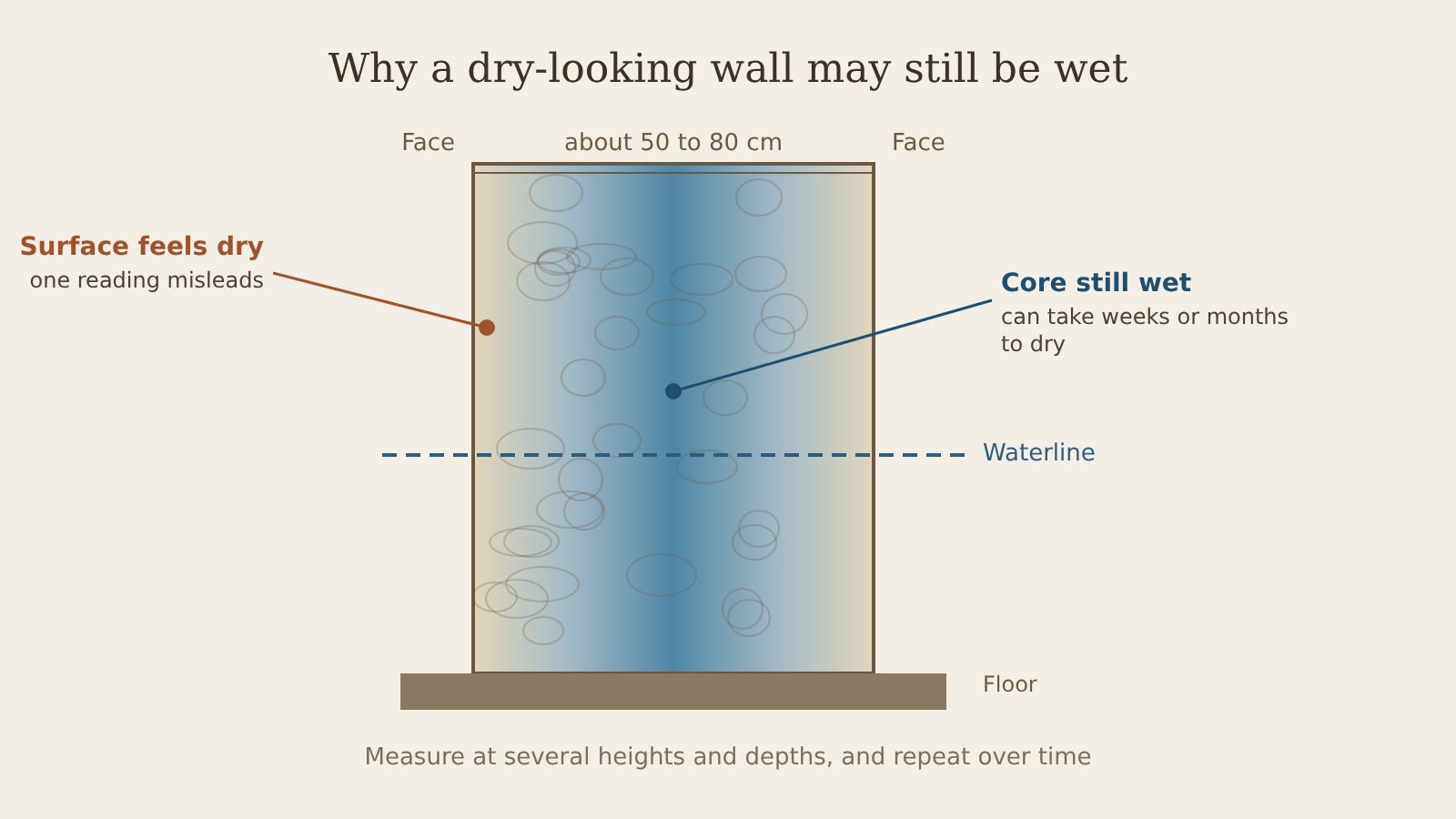
A useful assessment maps moisture over time rather than relying on a single surface reading:
Take readings at several heights on each affected wall, from near floor level to above the waterline, and consider both faces where accessible.
Choose methods suited to the material. Handheld electrical meters can be unreliable on stone, lime and salt-contaminated masonry. Measurements at depth or laboratory analysis of samples may provide better evidence, depending on the question being investigated.
Repeat measurements under comparable conditions to track the drying trend and document it for the claim.
Consider salt contamination. Floodwater may carry dissolved salts, sewage or agricultural runoff into masonry. As moisture moves and evaporates, salts may crystallise and damage porous materials.
Keep the record. If the file is closed after a visual inspection, later damage such as blown plaster, efflorescence, decayed joist ends or mould behind linings may be harder to connect to the flood.
Phase 4: Flood Recovery for Stone Houses Means Controlled Drying, Not Fast Drying
After a flood, drying contractors may arrive with industrial dehumidifiers, fans and heaters. These can be useful, but the right approach depends on the building and the materials. In pre-1948 stone buildings, aggressive or uneven drying can create additional problems. Agree the method with a professional who understands traditional masonry and monitor the results.
Risks of force-drying old walls
Salt crystallisation: as moisture moves towards an evaporating surface, salts may crystallise within pores. In some conditions, crystal growth can damage soft limestone and lime finishes.
Uneven drying: a steep moisture gradient between the surface and the wall core may contribute to cracking or loss of adhesion in plaster and mortar.
Timber movement: rapid changes in moisture content can cause old beams, joist ends and joinery to shrink or check.
A misleading finish line: a surface can appear dry while moisture remains deeper in the wall. Covering it too soon with impermeable paint or render may hinder further drying.
A measured approach
The aim is to remove trapped moisture while avoiding unnecessary stress to the building. A suitable plan may include:
Ventilate naturally on dry days, while maintaining security and avoiding humid outdoor conditions.
Remove materials that trap moisture, such as saturated plasterboard linings, wet insulation, vinyl wallcoverings and impermeable coatings. Assess cement renders and plastic-based finishes before removal; sound lime plaster may be retainable.
Use moderate, even background heat where appropriate. If dehumidifiers are used, select and monitor them for the building’s conditions rather than running at maximum output by default.
Repeat and record moisture measurements. Note efflorescence; brush dry deposits away rather than washing salts back into the wall.
Winter is coming: frost risk in wet walls
An autumn flood can leave masonry wet as frost arrives. Water expands by roughly 9% when it freezes, but the damage risk depends on the stone’s porosity, saturation and exposure, as well as the number and severity of freeze-thaw cycles. Lower courses and exposed faces may be particularly vulnerable.
During the first winter, keep the building suitably ventilated and heated where practical, maintain gutters and downpipes, and direct surface water away from the wall base. Avoid applying impermeable renders, sealants or water-repellent treatments to wet walls without specialist advice. Inspect external faces after hard frosts and record any new damage for the claim.
Phase 5: Reinstatement: Repairing Like with Like
Plan permanent repairs when the building has dried sufficiently for the proposed work. The right threshold depends on the materials and repair; do not rely on a single surface reading. Rushing to meet a contractor’s schedule or close an insurance file can make damage more expensive to put right.
Avoid repairs that create new moisture problems
After a flood, it can be tempting to tank lower walls, apply cement render or install a waterproof membrane to prevent a repeat. In traditional masonry, an incompatible or poorly designed barrier can redirect moisture and cause problems elsewhere. Specify repairs using materials compatible with the existing building: natural hydraulic lime (chaux hydraulique naturelle, NHL) or air lime (chaux aérienne) mortars and plasters where appropriate, vapour-permeable finishes such as limewash, and timber repairs matched to the existing species and condition.
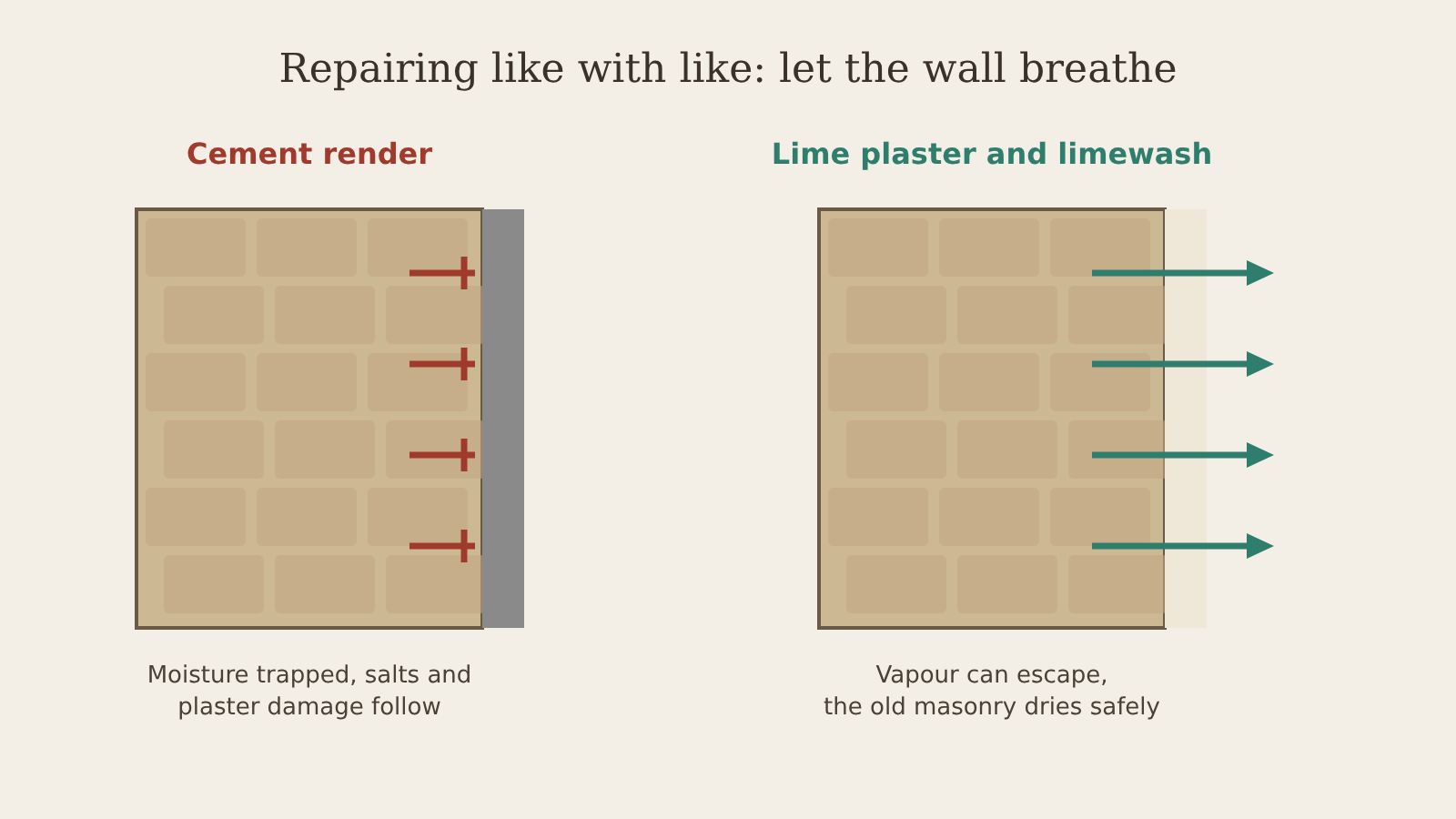
Lime work also needs suitable curing conditions. Lime mortar hardens through carbonation, as it reacts with carbon dioxide in the air. Protect fresh work from drying too quickly and from frost, and follow the product and conservation professional’s guidance. Do not apply new plaster to a wall that remains too wet for the chosen system.
Settle the claim on the right basis
The repair specification is part of your claim. If an estimate assumes gypsum plaster and acrylic paint for a house built with lime and stone, it may not allow for a compatible repair. Make sure submitted quotations explain the proposed materials, allow for appropriate drying and monitoring, and address damage that may become visible later, such as salt-damaged plaster or decayed joist ends. Before signing a final settlement (quittance), check that the scope reflects the known damage and any reasonable allowance for hidden damage.
Practical Checklist for Owners of Flooded Stone Houses
- Immediately: Confirm the building is safe to enter; keep the electricity off until an electrician has checked it
- Day 1: Photograph and film rooms, waterlines and damaged contents before removal; retain damaged items where possible
- As soon as possible: Notify your insurer in writing and keep proof
- First weeks: Ask the mairie whether it has applied for CatNat recognition; monitor the Journal officiel
- Within 30 days of publication: Make or confirm your loss declaration within the statutory deadline after publication
- Before the adjuster’s visit: Check policy cover for expert fees and consider appointing an expert d’assuré
- First weeks: Remove saturated moisture-trapping materials only after assessing the building; ventilate and dry in a monitored way
- Ongoing: Map moisture using suitable methods and repeat readings over time
- First winter: Maintain the building and monitor wet masonry through the frost season
- Once suitably dry: Use compatible repair materials and review the claim scope before signing a final settlement
Final Thoughts: Patience Is the Best Protection
Floodwater can do its damage in hours; a poorly managed recovery may cause problems for years. Owners are better placed when they document damage early, keep to claim deadlines, ask for an assessment that considers moisture inside the walls, and avoid rushing to dry and redecorate.
If your property has been flooded, or you are buying a house in a flood-prone part of southern France and want to understand its history and risks, I can carry out a moisture survey, assist as an independent expert d’assuré during the claim, and specify repairs suited to the building. Contact Damon A. Elliott through this website to discuss your situation.